Enterprise Translation
May 05, 2026
|
2 min read
From Translation to Transformation: Lessons from an Evening with LILT
Senior localization leaders from Lenovo and Mintel share candid lessons on scaling AI-powered translation across global markets. Key takeaways cover brand governance frameworks, translation memory as a compounding asset, when human review matters, and how to secure internal buy-in by framing localization as a revenue story.

LILT Team
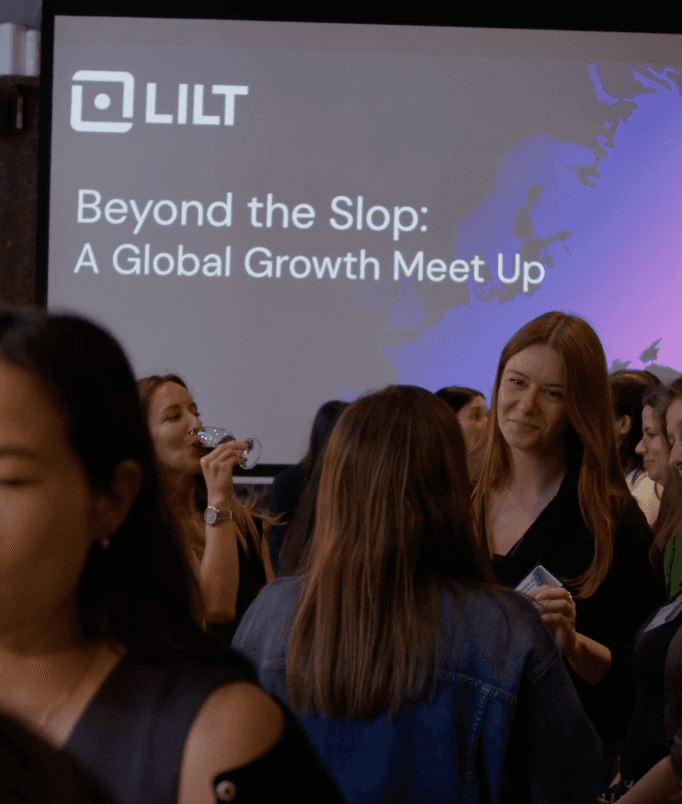
When two senior localisation leaders sit down to talk candidly about AI, you expect measured optimism and polished talking points. What you actually get at least at this particular evening is considerably more useful: hard-won process failures, frank admissions about organizational complexity, and a shared conviction that the companies winning with AI aren't necessarily the ones with the most sophisticated technology. They're the ones who have figured out the workflow around it.
Joining us on stage were Angus, Head of E-Commerce at Lenovo Europe, operating across 15 markets and 11 languages, and Xiao Xiao, a localisation leader at Mintel serving over 90 local markets across 20+ languages. Their conversation covered everything from brand governance to bad briefs, and what separates organizations that scale successfully from those that stall.
Why the Real Challenge in AI Localization Is Organizational, Not Technical
Both panellists were quick to reframe the central challenge. Yes, AI has made translation faster and, in many cases, better. But the harder problem, the one that actually determines success, is organisational, not technological.
"We're probably still only talking to about 10 to 20% of the different teams across the business — each with their own translation solution globally."
Angus Cormie, Head of E-Commerce, Lenovo Europe
At Lenovo, localisation isn't owned by a single function. It's distributed across dozens of teams each with its own agency relationships, workflows, and habits. Convincing a team in South Korea to abandon their trusted local agency in favour of a centralised AI-powered platform is, as Angus put it, a people problem, not a platform problem. Without a senior leader mandating consolidation globally, fragmentation persists.
For Xiao's organisation, the strategic challenge is equally nuanced: deciding, for each market and each service tier, how deep localisation needs to go and being honest about when "good enough" genuinely is good enough. Not every piece of content justifies the same investment. The art is in calibrating the effort to the revenue opportunity.
How to Maintain Brand Consistency Across 90+ Markets
The Governance Layer: Style Guides, Glossaries, and Brand Guardrails
Both panelists agreed on the scaffolding required to maintain brand voice across dozens of languages and markets: a strong style guide, a robust glossary, a well-maintained translation memory, and critically human governance at the top.
For Lenovo, this means a Global Brand Team that sets the non-negotiables, while individual functions like E-Commerce retain some freedom to adapt tone for their specific segments — gaming, students, small businesses — within those guardrails. The result is a layered system: fixed at the brand level, flexible at the segment and channel level.
"The key message has to be fixed. Local markets can run their own localization — but the brand message stays consistent."
Xiao Xiao, Director of Localisation, Mintel
Translation Memory as a Compounding Asset
Angus was emphatic on one point that often gets underestimated: translation memory is not a one-time setup. It's a continuously improving asset that needs to be fed with feedback from every published translation. The learning loop — getting input from linguists and in-market teams back into the LLM — is what drives compounding quality gains over time. Without it, you're starting from scratch on every project.
"We've talked about it in our QBR," he acknowledged. "But we've not succeeded yet in closing that loop fully. That's our next frontier."
Where AI Translation Still Falls Short in 2026
Neither panelist was here to sell AI utopia. When asked directly where AI still struggles, the answers were instructive.
The most common failure mode, Angus explained, isn't the model — it's the brief. "Crap in, crap out." A rushed brief, an unclear scope, an expectation that overnight turnaround will produce quality output: these are process failures, not AI failures. The organisations that are winning treat briefing as a discipline.
Beyond that, there's the broader context problem. A great AI translation engine doesn't know that your product feed contains untranslated specs, or that a piece of copy is destined for a high-stakes CTV campaign rather than a product page. Understanding the upstream and downstream context of every translation request and building processes to capture that is where sophisticated teams are investing their energy.
Key Takeaways from the Panel
- AI enables faster market coverage and quicker launches — but the workflow around it determines the outcome.
- Brand consistency requires fixed top-level guidelines, with structured flexibility at market and segment level.
- Translation memory is a compounding asset, it must be continuously updated with real feedback to deliver improving quality over time.
- The biggest failure mode isn't the model, it's bad briefs and weak upstream processes.
- Human-in-the-loop remains essential: not to check every word, but to apply contextual judgement at the right moments.
- Winning the internal buy-in argument requires framing localisation as a revenue and retention story, not a cost or language story.
When Is Human-in-the-Loop Translation Necessary?
The audience was curious about where human oversight is genuinely necessary versus where AI can run freely. Xiao's organisation has found a practical answer: for lower-stakes content, they publish AI translations directly, but with transparent labelling, so clients know what they're reading. For higher-value, higher-impact content, human review is non-negotiable.
Angus framed it differently. At Lenovo, it's human review every time but the nature of that review has evolved. In-market, mother-tongue reviewers have developed an intuition for what needs attention. A product specs page? Probably fine. The marketing blurb beneath the hero image? That needs eyes. The human expertise lies in knowing what to look at, not in reading everything.
How to Get Internal Buy-In for AI Localization
Perhaps the most practically useful part of the conversation centred on securing internal buy-in — a challenge that, according to LILT's own research, 80% of localization professionals struggle with.
Angus's advice: build the business case around cost, speed, and quality — and let the website do some of the persuading. "Everyone in the company has an opinion about the website and the copy. They'll tell you in a heartbeat if something sounds wrong in German." Improvements that are visible and tangible to non-specialists are your strongest advocates.
Xiao took a more strategic angle: speak the language of the boardroom, not the language of the language team. Revenue impact, client retention, conversion rates — these are the metrics that move senior leaders. The number of languages covered and the cost-per-word rate are interesting to localization managers. They're irrelevant to a CFO.
"Position localization in their language. They don't care how many languages you cover — they care what that means for revenue."
Xiao Xiao, Director of Localisation, Mintel
Key Panel Takeaways: What Separates Winners in AI Localization
After the panel wrapped, the conversation moved somewhere rather different — into the world of natural wine, small producers, and the surprisingly parallel story of Humble Grape.
Our host for the tasting, Ali — a Zimbabwean winemaker who spent his formative years in the Western Cape — walked us through a selection of wines chosen for a philosophy that resonated with much of what the panel had discussed: authenticity, provenance, and the value of working directly with producers rather than through layers of intermediary.
Humble Grape was founded in 2009 by James Dawson, another African-born Londoner, after a chance encounter with a Chablis in a Paris wine bar that sparked a curiosity he couldn't shake. Starting from a bicycle and a living room, the brand grew into seven wine bars and two South African-themed restaurants — a story of patient, values-led expansion not entirely unlike the localization journey our panellists described.
"From the vineyard, from the cellar, to us. There's a directness to it — and that's the ethos of the brand."
Ali, Humble Grape
The wines — including a soft Vinho Verde from Portugal and a Manzoni Bianca from a small Italian cantina — were chosen for their minimal intervention, organic and biodynamic farming, and low-sulphite approach. The goal, Ali explained, is to let the terroir speak without manufacturing the wine to fit a category. A philosophy, he noted, that works rather well for wine — and arguably for brand voice, too.
Looking Ahead: Why Workflow Will Define the AI Localization Winners
What separated this evening from a standard vendor event was the frankness of the conversation. Both panelists were willing to name where they're still figuring things out — the unclosed feedback loops, the fragmented organisation, the internal politics of consolidation. That honesty made everything else more credible.
The organisations that will win with AI in global markets over the next 24 months, both agreed, won't necessarily be those with the most sophisticated models. They'll be the ones who have industrialised the workflow around those models — who have built feedback loops, invested in governance, trained their teams to brief well, and resisted the temptation to treat AI as a department-level shortcut rather than a company-wide capability.
That's a harder problem than buying the technology. It's also a more durable competitive advantage once you've solved it.
--------------------------------
This recap is based on a live panel discussion. Quotes have been lightly edited for clarity.
Share this post


Find some time with LILT
Enterprise-grade content seamlessly translated with AI to help your business scale globally.
Book a MeetingShare this post