Enterprise Translation
June 23, 2026
|
3 min read
From 2 Languages to 20: Localization as a Growth Lever for Global Product Launches
Localization is a growth lever, not a cost center. Product leaders from Zeta, Amazon, and LILT explain how to scale from 2 to 20 markets: treat multilingual as a core product feature, let adaptive AI do the heavy lifting, keep humans on brand-critical work, and prioritize markets by demand and readiness.

LILT Team
Every growing company hits an inflection point where global expansion becomes the clearest path to the next stage of growth. The trouble is that the spreadsheet that worked for two languages can't carry you to twenty.
Localization usually starts as a few product strings in a spreadsheet. But true international scaling means localizing a fragmented web of content: help docs, support tickets, marketing campaigns, developer documentation, each flowing through a different system, with a different quality bar and a tight turnaround time. The companies that scale globally treat that complexity as a product problem to be designed for, not a translation task to be outsourced. That single mindset shift is what separates the businesses that reach twenty markets from the ones that stay stuck in a handful.
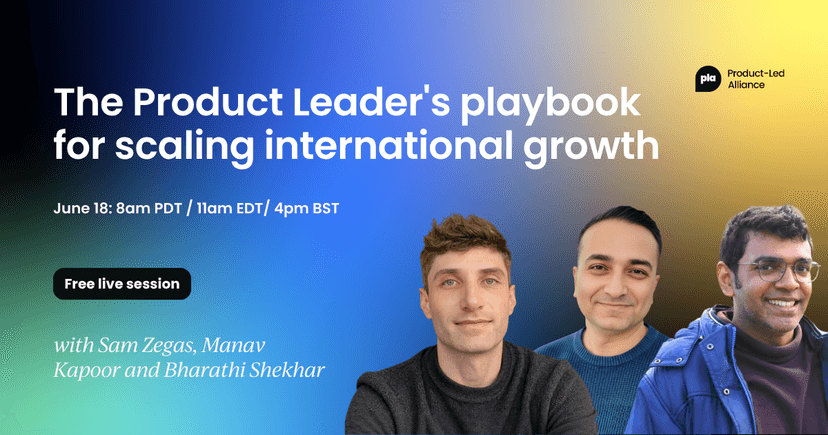
In a recent Product-Led Alliance session, From 2 Languages to 20: The Product Leader's Playbook for Scaling International Growth, three product leaders who have lived this journey unpacked how to make that shift: Bharathi Shekar, Director of Product at Zeta; Manav Kapoor, Senior Technical Product Leader at Amazon; and Sam Zegas, VP of Product Strategy & Agentic Operations at LILT. Here are the ideas worth taking back to your roadmap.
Reframe localization from a cost to a growth lever
Most companies still treat localization as a cost center, a box to check near the end of a build, then hand off to a vendor. According to Sam Zegas, that framing is the first thing to fix.
"The reframe is to shift your mindset from the cost to the revenue opportunity," he said. "Instead, you should treat multilingual experiences as a core product feature, on the same footing as things like performance or accessibility. So when you talk to leadership, you should pivot away from things like the cost per word and start focusing on capturing new revenue."
He pointed to two ways localization drives growth. The first is market access: LILT customer UiPath "unlocked massive amounts of revenue that they had been leaving on the table simply by making the product accessible in their customers' own language in a hundred different markets." The second is speed. "Teams don't realize that their global launches are slow because there are a lot of manual handoffs," Zegas said. Engineers copy-paste strings by hand, files get emailed around for review. Replace that with a scalable, automated process and delivery times drop sharply: LILT customer Lenovo "cut delivery times by about 60% once they moved to a fully automated multilingual pipeline."
Both panelists reinforced the point from the practitioner's seat. For Bharathi Shekar, the mistake is treating language as a line item rather than a strategic decision. "You should think about supporting a new language as a completely new product journey itself, supported by the necessary business case," she said. "The actual act of converting text from one language to another is a very, very small line item in the whole scheme of things. There are things like cultural nuances and how the brand is perceived. All of that is super important before you make the decision."
Manav Kapoor framed the stakes in terms of trust. "It's not just apples-to-apples, word-by-word translation," he said. "Sometimes you have to introduce a different set of words to mean the same thing, because culturally they're read differently. Calling something out can be simple and layman in one language, but in a different geography it can be rude." Get it wrong and the brand pays for it: "It's the brand and customer trust which is exposed and at risk. When one customer is unhappy, they may end up talking to four different people." The takeaway across all three panelists: localization is a feature, and a growth lever, that deserves to be designed for from the start, not an add-on at the end of the product lifecycle.
Use AI for the heavy lifting, and keep humans where it counts
AI has transformed what's possible on translation speed and cost. It has also raised hard questions about quality, brand consistency, and trust. The panel was aligned on how to think about it: not as a binary choice, but as a system.
"There's a misconception that AI is this cheap-but-low-quality alternative versus a slow and expensive human option," Zegas said. "The way I see it playing out is that companies are leveraging AI for the heavy lifting, the high-volume day-to-day stuff, while keeping their human translators and reviewers in the loop but focused on the things that are higher-risk or brand-critical."
What is an adapted translation model?
The differentiator, he explained, is an adapted model rather than a generic one. "The idea of cheap, low-quality AI translation is really related to generic models, which don't have any domain-specific vocabulary, so they wouldn't get a branded term right." Adapted models, by contrast, are trained on a customer's own data and improve continuously. "Miro, for example, saw an 18% increase in accuracy when they made the switch over to our adapted models." That improvement comes from a self-reinforcing loop: at LILT customer Equals Money, content runs through an AI pass first, then human verifiers review and improve it, "and anytime a human corrects the term, it triggers a real-time retraining process so the model doesn't make that same mistake next time. The adapted model is really an asset that becomes more valuable over time."
Where should humans stay in the loop?
That human-in-the-loop philosophy was where Manav and Bharathi most directly amplified LILT's view. Kapoor noted that human oversight is increasingly not just a quality choice but a regulatory one: "The EU AI Act makes sure that humans are in the loop, especially for AI-driven actions which are completely automated." Shekar put a finer point on it: "No matter how much you invest in AI, there is a strong need for human governance in the loop. You need humans who finally vet what's coming out," across brand, marketing, and experience reviews. In other words, you can delegate the work to AI; you can't delegate the thinking. That's precisely the adaptive, human-verified model LILT is built around.
Prioritize markets by demand and readiness, then go deep
When it comes to choosing which language or market to add next, the panel cautioned against starting with language at all. Shekar's framework comes down to two assessments. First, an opportunity assessment: "Does it mean more revenue, more margins, or does it give you any scale advantages?" Second, a readiness assessment: "Do you have to keep regulation in mind? Can you leverage your existing brand as-is, or do you need to tweak it? Do you have the people ready to support your customers?" Plot the two on a simple two-by-two, she advised, and let that, not translation cost, drive the decision.
Kapoor agreed that localization is "just one of the product features that come into the mix," and recommended sequencing by data maturity: "I prefer starting with more established markets, because I have a lot more data and control on how my customers will react. ROI and demand are the driving forces."
Zegas built directly on those points, splitting the question into market demand versus market readiness, and offering LILT's hard-won lesson: go deep before you go wide. "The trap is going too wide too fast. The teams that scale best focus deeply on a few markets." LILT customer Equals Money "anchored in three languages other than English (Spanish, French, and Dutch) to start, and that protected them from the drain of trying to launch 20 at once while they were still getting used to the workflows." Readiness also depends on content type, not just language: some formats are far harder to move reliably through a workflow than simple product strings. And the connective work is getting easier. "There's a lot of interesting progress happening in the world of MCP," Zegas said, making it possible to plug translation workflows directly into the tools teams already use.
Build a minimum viable localization stack, and don't pick a static engine
For teams still at the "two languages on a spreadsheet" stage, Zegas offered three foundations to put in place before scaling. First, the linguistic assets: "a glossary, a do-not-translate list, and a clean translation memory. This might sound like dry administrative work, but it's extremely high-leverage." LILT customer Box "put a lot of early focus on that exact hygiene." Second, kill the manual file shuffling: "Ditch that manual workflow as early as you can. It's time-consuming and error-prone." Third, define quality needs by content type so the most expensive human verification goes only where the risk justifies it.
His one rookie mistake to avoid doubles as LILT's core product thesis: "Do not pick a static AI engine that can't learn from your edits. That should be considered table-stakes functionality."
Kapoor extended the content-type point with a regulated-industry example: terms and conditions "can frequently change as the rate changes, so you want to be very flexible and quick," while value-prop messaging moves more slowly, and your system should treat them differently, learning from human feedback as it goes. Shekar brought it back to intent: "It's a very fundamental question they should ask: what is the strategy? If you're actually thinking about expanding into new markets, you need to get into investment mode. It cuts across people, technology, and processes."
Make the business case in the language of growth
Many product leaders struggle to justify investing in localization infrastructure versus just getting translations done. The panel's advice: tie it to the metrics leadership already cares about.
"Always tie it back to the core metric driving the business," Kapoor said: expansion, retention, onboarding, engagement. "Say, 'You give me X dollars, I'm going to give you 2X in return.'" He flagged a second, often-missed angle: "The engineering opportunity cost. Platform products sit across different products, so you can make the case holistically and get a lot more buy-in." Shekar framed it as a trade-off backed by evidence: the new-market opportunity "needs to be on par or better with what you're doing already," and sometimes the first investment is simply in collecting the data to decide.
Zegas seized on the keyword: investment. "There's an outdated mindset that thinks of translation as an expense on services, as opposed to an investment in an appreciating asset in the form of infrastructure and adapted models, something that makes it continuously cheaper and faster with each cycle." The metrics that land, he said, are speed to market and unit economics, and the proof points are concrete: ASICS "lowered their total costs by 70%" with an infrastructure approach, and Intel "cut their resource spend by 50% while still increasing the amount of content they were outputting." Finally, name the cost of the status quo: "Every day you spend in manual workflows, you're using engineering time inefficiently and introducing compliance risk." LILT customer ChargePoint, for one, consolidated localization from "three separate disconnected silos" into a single integrated system that "ran so much more efficiently than before."
That shift, from managing vendors to driving growth, is exactly what customers describe once the infrastructure is in place. As Alessandra Binazzi, Director of Localization at ASICS Digital, put it: "LILT's vertically-integrated solution has had huge efficiency gains for ASICS. Now I finally have time to think more strategically about how localization can help grow our business, instead of spending all my time managing vendors."
The one piece of advice: start with the end in mind
Asked what they'd tell themselves back at the two-language stage, the panel converged on a single idea.
"Start with the end in mind," Shekar said. "I made the mistake of just saying, 'Let's translate this product into a different language and launch it.' Now I know it's such a small piece in the entire puzzle. Who is the customer? Why are we doing this? What regulatory boundaries am I crossing? What's the support model?"
Zegas couldn't agree more, and named the end state. "The goal is to make multilingualism a fundamental property of the product, rather than a step you complete before the launch." Skip the infrastructure even at two languages, he warned, "and it's going to lead to tech debt you'll need to fix later." His third principle is flexibility: build "plug-and-play to wherever your content is and wherever your people are already working," whether through MCP integrations or connectors to tools like Figma and GitHub.
Kapoor closed on the same theme: "Spend adequate time planning. Figure out the problems in your tech stack, not just localization, and start fixing those architectural issues from the get-go, so you're not hit by a big cost to swallow later."
Across every question, the panel returned to one reframe: localization is not a back-office cost to be minimized. It's a product feature, a speed lever, and an appreciating infrastructure investment that, done right, is one of the most measurable growth levers a product leader has. The companies pulling ahead design for it early, let adaptive AI do the heavy lifting, keep humans in the loop where brand and risk demand it, and treat going multilingual as a fundamental property of the product rather than a step before launch.
---------------------------------------------------------------------------------
Want the full playbook? Download the guide of Using Multilingual AI to Reduce Time-to Market for Product Launches for the frameworks, examples, and trade-offs in the panel's own words.
Ready to make multilingual a growth lever? Book a demo with LILT to see how customer-specific adaptive AI and human verification help enterprises scale content faster, more accurately, and at lower cost.
Share this post


Find some time with LILT
Enterprise-grade content seamlessly translated with AI to help your business scale globally.
Book a MeetingShare this post